
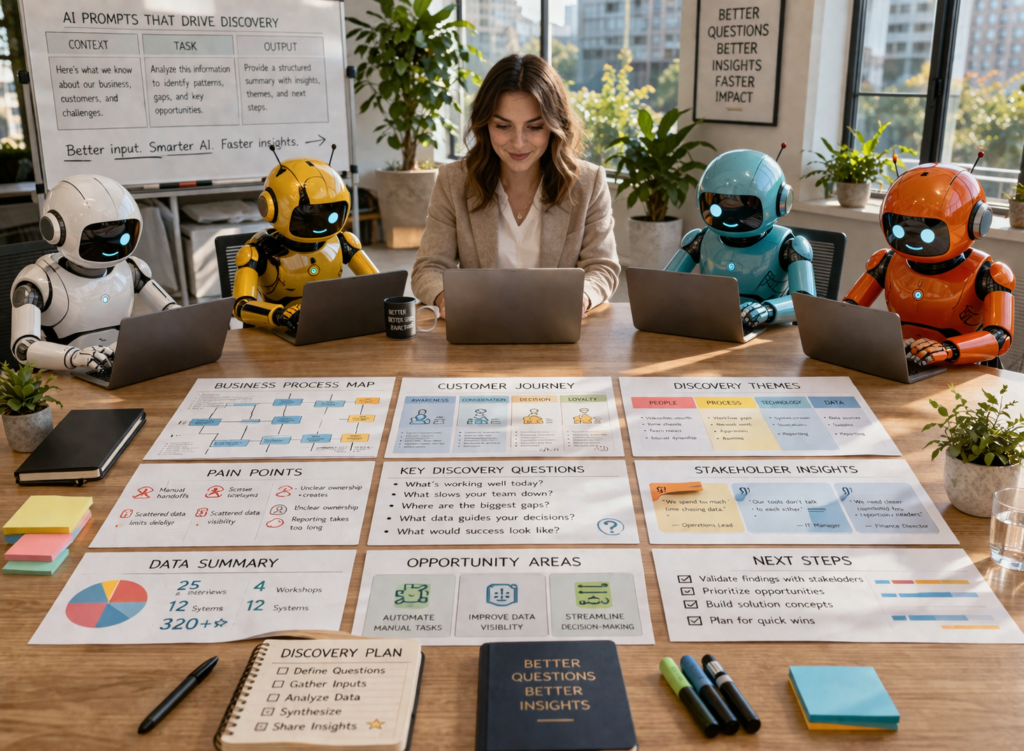
Discovery work is often slowed by language before it is slowed by logic. Stakeholders describe the same problem in different terms. Workshops generate useful ideas, but they arrive in overlapping fragments. Interview notes contain patterns, though those patterns are buried inside too much context to use quickly.
That is why AI can be helpful in discovery. Not because it replaces judgment, but because it speeds up the first pass of synthesis. It helps consultants organize what people are saying before they decide what it means.
The most reliable prompt structure for this kind of work is simple. Start with context, then objective, then input, then the output format you want, and finally the constraints. That sequence matters because it keeps the model inside the actual task instead of letting it drift into generic consulting language.
Use workshop synthesis prompts to turn raw notes into visible patterns
Workshop notes are often dense, repetitive, and hard to scan. The first useful move is to ask AI to organize what happened without jumping too quickly to recommendations.
What to do is straightforward. Paste in the workshop notes, tell the model what kind of project this is, and ask it to surface recurring pain points, unresolved questions, and areas of agreement or tension. The output should be structured, not open-ended.
How to do it in practice is to specify both the job and the boundaries. A prompt like this works well:
We are running discovery for a customer support process redesign. Using the workshop notes below, identify the top recurring pain points, unresolved questions, and points where stakeholders appear to disagree. Present the output in three sections and do not suggest solutions yet.
That last instruction matters because it keeps the model in discovery mode. Without it, the response often moves into recommendations before the real shape of the problem is visible.
Use interview-clustering prompts to find themes across stakeholders
Interview notes are where patterns usually begin to emerge, but they are also where nuance gets lost if everything is summarized too quickly.
What to do here is combine several interview notes and ask AI to group comments into themes rather than summarizing each interview separately. This helps the consultant see recurring issues, repeated language, and points of difference across roles.
How to do it well is to ask for grouped themes and disagreement, not just themes alone. For example:
Review the interview notes below and group the comments into recurring themes. For each theme, include which stakeholder groups raised it, where people disagree, and any assumptions that appear repeatedly but remain untested.
That structure helps preserve tension instead of flattening it. In discovery work, disagreement is often more useful than consensus because it tells you where the next questions need to go.
Use question-generation prompts to prepare for the next workshop or interview
One of the best uses of AI in discovery is preparing better questions. Once early notes are organized, the next step is usually not to generate solutions. It is to sharpen the inquiry.
What to do is feed the model the current notes and ask it to generate follow-up questions that target the gaps in understanding. Those gaps usually sit around ownership, process bottlenecks, approval rights, user pain, or implementation constraints.
How to do it well is to tell the model exactly what kind of questions you need. A broad request produces broad output. A tighter request produces better workshop material. For example:
Based on the notes below, generate 10 follow-up questions for our next stakeholder workshop. Focus specifically on unclear ownership, process bottlenecks, approval delays, risks, and decision rights. Keep the questions short and practical.
This is most useful when the consultant reviews and edits the questions rather than using them verbatim. The value is speed and range, not perfect wording.
Use assumption-mapping prompts when the team is moving too fast toward answers
Discovery often weakens when the room starts rushing toward a preferred solution before the assumptions underneath it have been tested.
What to do at that point is ask AI to identify what the team appears to be taking for granted. That might include assumptions about users, internal ownership, technical feasibility, process maturity, or leadership alignment.
How to do it in practice is to ask for an assumption log rather than a loose summary. For example:
Review the notes below and identify the assumptions being made about users, process constraints, stakeholder alignment, technical feasibility, and implementation readiness. Present them as an assumption log with three columns: assumption, why it matters, and what would need to be validated.
That prompt works because it turns vague concern into something the team can inspect. It also gives the consultant a stronger way to slow down premature certainty without simply telling the group to think harder.
Keep the rough edges visible during review
AI is very good at smoothing complexity into something neat. Sometimes that is exactly what we want. Sometimes the rough edges are the point. If stakeholders disagree on ownership, process pain, or decision rights, the model should not be allowed to iron that out into artificial consensus.
That is why review is still part of the craft. The first draft can be accelerated. The interpretation still needs judgment.
For consultants running collaborative workshops or early-stage discovery sessions, the stronger commercial path here is usually a practical resource first: a discovery prompt pack, a workshop synthesis template, or a simple assumption log that can be reused across projects. Miro then becomes a natural supporting tool because it gives the team a shared space to gather raw input before AI is used to synthesize it into something more structured.
Good prompt structures do not automate discovery. They reduce the cost of the first pass so the real discovery work can happen with more clarity.
A useful next step for readers would be a small resource tied to this article, such as a copy-ready discovery prompt pack or a workshop synthesis worksheet. That kind of asset would make the article easier to apply immediately, while also giving consultants a clearer bridge from method to practice.
References
- Ethan Mollick, Co-Intelligence — Penguin Random House: Co-Intelligence — https://www.penguinrandomhouse.com/books/723708/co-intelligence-by-ethan-mollick/
- OpenAI prompting best practices — OpenAI Help Center: Prompt engineering best practices — https://help.openai.com/en/articles/6654000-best-practices-for-prompting
- Donald Schön, The Reflective Practitioner — Basic Books — https://www.hachettebookgroup.com/titles/donald-a-schon/the-reflective-practitioner/9780465068784/
Recommended Articles
Best Note-Taking Systems for Consultants
How Digital Consultants Can Use AI to Draft Better Meeting Notes
Forever Scope Creep Triggers in Projects
A Practical Guide to Managing Multiple Stakeholders Without Chaos