
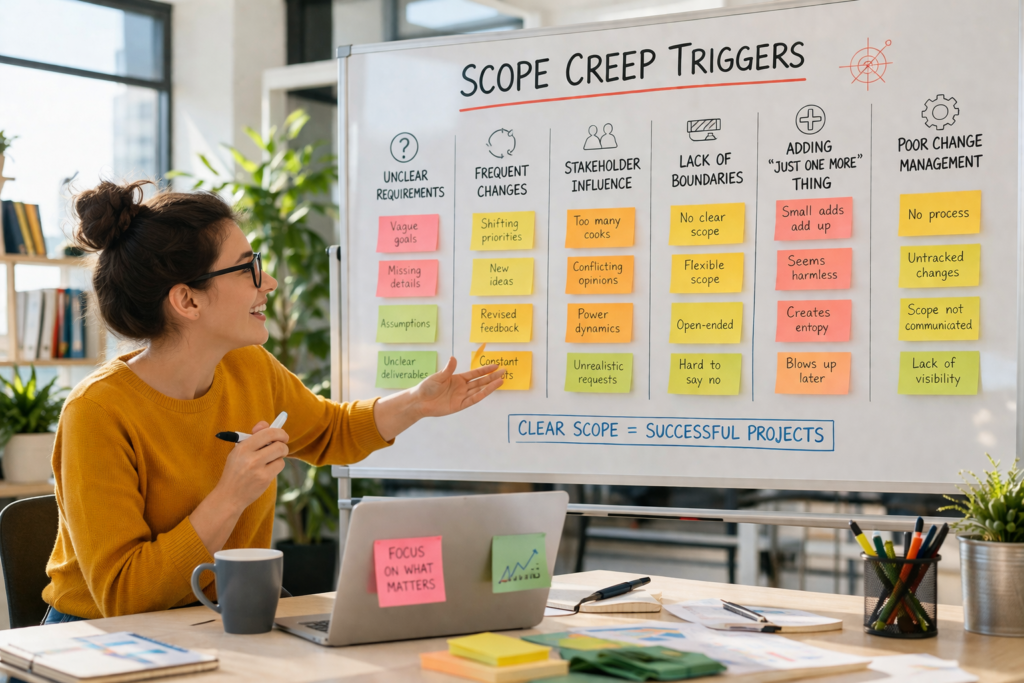
Scope creep rarely arrives in a dramatic form. It usually appears through small, reasonable moments that seem too minor to challenge. A request sounds adjacent enough to include. A workshop insight opens another line of work. A new stakeholder joins and understandably wants to shape the outcome. None of this looks dangerous on its own. The problem is accumulation.
That is why scope creep is less about one difficult client and more about the conditions that allow expansion to happen without explicit choice. In digital consulting, those conditions are often surprisingly ordinary.
It starts with vague deliverables
When a statement of work relies on broad language such as “support implementation,” “refine the strategy,” or “assist with stakeholder alignment,” people naturally fill the gaps with their own expectations. The work begins stretching before anyone feels they have formally asked for more. Deliverables do not need to become rigid, but they do need to become specific enough that later additions can be recognized as additions.
It grows when more voices enter the room
Many projects begin with one sponsor and then slowly acquire a wider approval circle. Each new stakeholder brings reasonable questions and useful perspective, but without clear decision rights that extra input can become unofficial scope. The project starts responding to more people than it was designed to carry.
This is especially common in digital consulting, where workshops, platform decisions, and process redesign work tend to attract cross-functional interest very quickly.
Discovery can quietly become expansion
Early discovery is supposed to reveal complexity. That is part of its value. The problem starts when discovery becomes an open-ended container for every adjacent issue the organization wants to discuss. Process issues turn into governance issues. Governance issues turn into tool-selection conversations. Tool-selection conversations turn into implementation expectations.
If those shifts are not named clearly, the project begins absorbing new work by implication rather than agreement.
Helpful teams often create their own scope problem
Consultants are often partly responsible for scope creep because saying yes feels commercially smart in the moment. A quick extra review, a small workshop adjustment, an additional round of edits, or a side conversation with another stakeholder can all feel too minor to log formally.
But patterns matter more than single moments. Informal accommodation becomes much harder to unwind once the client experiences it as normal responsiveness rather than additional effort.
Weak change control finishes the job
A light change process solves more than people think. It does not need to be bureaucratic. It just needs to make visible when something new is being added, what it affects, and whether everyone agrees on the consequence for timeline, effort, or priority.
Without that structure, scope conversations are handled through tone, memory, and goodwill. That is usually when the project begins to feel generous at the start and exhausted by the end.
Scope control is not about being difficult. It is about keeping flexibility conscious, so the work can expand by decision rather than by drift. That process becomes easier when requests, decisions, and next steps are tracked in one place. In practice, this usually works best when the team pairs a simple change log or scope tracker with one shared workspace. ClickUp is a strong fit here because it makes requests, decisions, and next steps visible before they turn into invisible delivery load.
References
- Project Management Institute, guidance on scope and change control — PMI — https://www.pmi.org/
- William Ury, Roger Fisher, and Bruce Patton, Getting to Yes — Penguin Random House: Getting to Yes — https://www.penguinrandomhouse.com/books/330682/getting-to-yes-by-roger-fisher-william-ury-and-bruce-patton/
- Daniel Kahneman, work on optimism bias — The Decision Lab: Optimism Bias — https://thedecisionlab.com/biases/optimism-bias
Recommended Articles
Best Project Management Tools for Consultants