
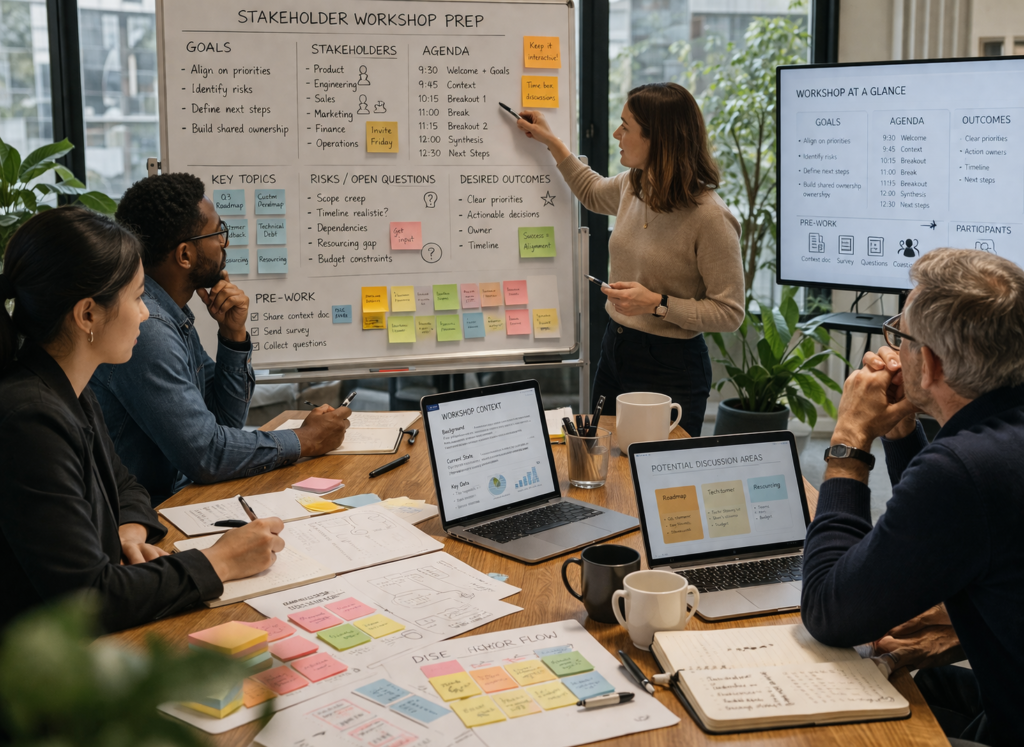
What happens in the room is only as good as what happened before it. Here is how to prepare for stakeholder workshops in a way that actually changes outcomes.
There is a particular kind of silence that settles over a stakeholder workshop when it is not going well. Participants look at the agenda without recognition. Someone asks a clarifying question that should have been answered two weeks ago. A senior voice in the room redirects the conversation toward a topic that was never the point. And the facilitator — you — tries to hold the thread together while quietly calculating how much of the original plan can still be saved.
Most consultants who have run workshops will recognise this. What is less often acknowledged is that the moment it starts going sideways is almost never in the room. It is in the preparation — or the lack of it. A well-prepared stakeholder workshop does not just run more smoothly; it produces materially better outputs. Participants arrive aligned on context, the agenda reflects their actual needs, and the conversation moves quickly into genuine problem-solving rather than extended scene-setting.
The research supports this. Workshops where participants dedicate at least four hours to preparation show a 40% boost in decision-making efficiency. That is a significant return on an investment that costs nothing except time and deliberate design. This article focuses entirely on what happens before the workshop begins — the preparation framework that separates a session that generates momentum from one that generates a follow-up meeting to discuss what the first meeting was supposed to decide.
Start with the purpose, not the agenda
The most common preparation mistake is building the agenda before clarifying the purpose. It sounds basic, but it happens constantly — often because consultants are under time pressure and default to structure as a proxy for clarity. An agenda gives the appearance of preparation without requiring the harder work of articulating what the workshop actually needs to produce.
Before you open a slide deck or a planning tool, write a single sentence that describes what the workshop must deliver. Not what it will discuss. Not what it hopes to explore. What it must produce. If you cannot write that sentence clearly, you are not ready to design the session — and neither is the client.
A useful distinction here is between tangible and intangible outcomes. Tangible outcomes are the concrete deliverables: a prioritised backlog, a signed-off roadmap, a set of agreed risk owners. Intangible outcomes are equally important but harder to specify: shared understanding of a problem, alignment between teams that have been working at cross purposes, or a group of senior stakeholders who leave feeling heard rather than managed. Good workshop design holds both in view simultaneously.
Once the purpose is clear, break it into concrete objectives — typically three to five specific questions the workshop will answer or decisions it will make. These objectives become your filter for every subsequent preparation decision: who to invite, what to include in the pre-read, how to sequence the agenda. Anything that does not serve at least one of the objectives is a candidate for removal.
“Define the workshop objective. Write a single sentence describing what the workshop must produce. If you cannot state the objective clearly, you are not ready to facilitate.”
Conduct pre-workshop interviews — they change everything
If there is one preparation practice that most consistently separates effective workshop facilitators from average ones, it is the pre-workshop interview. These are brief one-to-one conversations — typically 20 to 30 minutes — held with key participants in the week before the session. Their purpose is to understand each stakeholder’s perspective, surface concerns that will not be voiced in a group setting, and identify where alignment exists and where it does not.
The intelligence you gather from these conversations is irreplaceable. It tells you which topics are genuinely open for discussion and which have already been decided. It surfaces the interpersonal dynamics — who defers to whom, who tends to dominate, who holds a strong view they are unlikely to share publicly. And it gives participants a sense of ownership over the session before it has begun, which dramatically increases engagement on the day.
Pre-workshop interviews also allow you to validate your agenda against the actual needs of the room. More than once, a consultant has arrived at a pre-interview planning to cover a particular topic only to discover that the participant’s primary concern is something else entirely — something that would have derailed the session had it surfaced without warning. A well-designed pre-interview process converts those surprises into design inputs.
Keep the interviews focused. A simple structure works well: open with a question about their expectations for the session, move to their perspective on the topic or challenge at hand, probe for concerns or reservations, and close by asking whether there is anything the facilitator should know that might not come up in the group. The last question consistently produces the most valuable answers.
Actionable tip
Create a brief interview notes template and capture findings from each conversation immediately afterwards. Before finalising the agenda, review your notes across all interviews and look for patterns — recurring themes, unresolved tensions, or gaps between what different stakeholders believe is true. These patterns should shape the session design directly.
Design the pre-read as a preparation tool, not a briefing document
Most pre-reads are too long, too dense, and treated by participants as optional. This is partly a formatting problem and partly a design problem. The formatting problem is that consultants default to the same document style they use for client deliverables — comprehensive, evidence-heavy, and written for an audience that will spend time with it. The design problem is more fundamental: the pre-read is often written to inform rather than to prepare.
A well-designed pre-read is not a summary of what the consultant knows. It is preparation for the specific cognitive work the session will require. Think of it as the first item on the workshop agenda — something that gets the meeting off to a fast start by ensuring participants arrive with the main topics already fresh in their minds. This means the pre-read should be structured around the workshop’s objectives, not around a logical narrative of the project.
Practically, this means keeping it short. Two to four pages is enough for most sessions. Include an executive summary of the problem or opportunity being addressed, the key data or context participants need to engage meaningfully, the specific questions or decisions the workshop will address, and a clear signal of what you expect them to bring — their perspective, a prepared response, a specific example from their experience.
Sending materials ahead of time allows participants to familiarise themselves with the material and come prepared. But the key is to make the pre-read genuinely useful rather than merely thorough. Write it with the least-informed participant in mind. If a stakeholder who is three steps removed from the day-to-day project can read it and arrive with a clear understanding of what they are there to contribute, it has done its job.
Actionable tip
Include a single preparation question at the end of your pre-read — something specific that you will ask participants to share in the first ten minutes of the session. This creates accountability for actually reading the material and ensures the session opens with substance rather than scene-setting. Something like: “Based on what you have read, what do you see as the single biggest obstacle to the outcome we are trying to achieve?”
Tools worth knowing:
- Notion — Ideal for building and sharing pre-read documents that participants can access, annotate, and comment on asynchronously before the session. A shared Notion page allows you to see who has engaged with the material and collect early responses to your preparation question.
- SessionLab — A purpose-built workshop planning tool that allows you to design agendas, attach pre-read materials, and invite clients and stakeholders to co-create the session plan in real time or asynchronously. Its state of facilitation reports are also an excellent ongoing resource for workshop design best practice.
Build an agenda that reflects the room you are walking into
A workshop agenda is not a running order. It is a hypothesis about how a group of specific people, with specific perspectives and relationships, will best reach a specific outcome in a specific amount of time. That distinction matters because it means the agenda cannot be designed in isolation from your knowledge of the participants — which is precisely why the pre-interviews and pre-read design come first.
A commonly cited rule of thumb is that it takes at least twice the time to design a workshop as to deliver it. A two-hour session should represent at least four hours of design work. This is not an exaggeration. The thinking time embedded in agenda design — sequencing activities, calibrating time allocations, deciding what to leave out — is what makes the difference between a workshop that feels effortless to participate in and one that feels laboured.
In terms of structure, effective workshops generally follow a diverge-then-converge pattern: open with activities that surface perspectives and generate ideas broadly, then move toward synthesis, prioritisation, and decision. The ratio of time spent on each phase should reflect the workshop’s primary objective. A session focused on alignment needs more divergent time early — more space for different voices to be heard before convergence. A session focused on decision-making can move to convergence sooner if alignment already exists.
One practical design decision worth particular attention is participant numbers. For working sessions where decisions are made, four to eight participants is the recommended range. Beyond eight, side conversations start, available airtime per person drops, and facilitation becomes significantly harder. For alignment or information-sharing workshops, up to fifteen can work if you use structured activities like silent brainstorming and dot voting. Knowing this in advance allows you to push back constructively if a client’s initial invitation list is too broad for the session’s purpose.
The 2025 facilitation report also highlights a shift in session length norms: average workshops have shortened to around 90 minutes, reflecting digital fatigue and shorter collective attention spans. If your objectives genuinely require more time, consider running a series of focused 90-minute sessions rather than a single extended one. Shorter, well-designed sessions with clear outputs consistently outperform long, open-ended meetings.
Actionable tip
Once you have a draft agenda, share it with one person from the client side — ideally the workshop sponsor — before it is finalised. Run through it together, check that the sequencing reflects their understanding of the group, and invite them to flag anything that feels misjudged. This five-minute conversation often surfaces a critical piece of context about participant dynamics or organisational sensitivities that reshapes the design in a meaningful way.
Tools worth knowing:
- Mural — A digital canvas that supports pre-workshop planning and in-session facilitation. Its pre-work templates allow participants to contribute asynchronously before the session, and its real-time collaboration features make it well suited for hybrid or fully remote workshops.
- Miro — Similar to Mural, Miro’s workshop templates — including stakeholder maps, affinity diagrams, and voting boards — are widely used by digital consultants for both preparation and facilitation. Its integration with tools like Notion, Jira, and Slack makes it easy to embed in an existing client workflow.
Prepare for the dynamics, not just the content
Content preparation — the pre-read, the agenda, the materials — is the visible part of workshop preparation. Dynamic preparation is less visible but equally important. It is the work of thinking through what will happen in the room between people, not just on the whiteboard.
Every workshop has a social architecture: patterns of authority and deference, voices that tend to dominate, participants who hold strong views privately but rarely share them publicly, and potential fault lines between teams or functions that could surface unexpectedly. Effective preparation means mapping this architecture in advance and designing for it deliberately.
If you know that one participant consistently dominates group conversations, build structured activities that distribute airtime — silent individual reflection before group discussion, small breakout groups before plenary sharing, or written responses before verbal ones. If you know that two stakeholders hold conflicting views on a core question, consider sequencing the agenda so that their perspectives are surfaced in a structured way rather than colliding unprepared in an open discussion.
It also helps to prepare for the session that does not go to plan. The most experienced facilitators carry a mental toolkit of alternative activities they can deploy if an exercise is not working, if a discussion moves faster than expected, or if the energy in the room drops at a critical moment. Having two or three backup activities prepared — a quick polling exercise, a reframing question, a paired conversation — means you can pivot without appearing to lose control.
The pre-workshop checklist: a practical closing tool
In the 24 to 48 hours before the session, a brief structured review of your preparation prevents the small oversights that can undermine an otherwise well-designed workshop. Here is a practical checklist worth working through before any stakeholder session:
- Has the purpose and the specific workshop objectives been confirmed with the sponsor in the last week?
- Have pre-workshop interviews been conducted with all key participants — or at minimum, the most influential ones?
- Has the pre-read been sent with sufficient lead time (ideally five to seven days) and does it include a specific preparation question?
- Does the agenda reflect findings from the pre-interviews — and has it been reviewed with the client sponsor?
- Is the participant list the right size for the session’s purpose, and do all invitees understand why they are there?
- Have logistics been confirmed — venue or virtual platform, technology, materials, roles for any co-facilitators?
- Are backup activities prepared for the most likely disruptions?
- Is there a plan for capturing outputs — who is documenting, in what format, and what gets shared with participants afterwards and when?
None of these items is individually complex. Together, they represent a preparation standard that ensures the session you designed is the session that actually runs.
Key takeaway
A well-run stakeholder workshop is the product of deliberate, structured preparation — not natural facilitation talent. The consultants who consistently run sessions that produce real outcomes are not necessarily the most charismatic people in the room. They are the ones who did the work before they walked in: clarifying the purpose, interviewing the participants, designing the pre-read, building an agenda that reflects the actual dynamics of the group, and thinking through what the room will feel like, not just what the slides will say.
References
- SessionLab. (2024). A step-by-step guide to planning a workshop. sessionlab.com
- SessionLab. (2024). Agenda design 101: how to craft a successful agenda design. sessionlab.com
- Delib. (2025). How to plan a stakeholder workshop: best practices. delib.net
- Mural. (2024). Pre-work: your guide to before-the-meeting action items. mural.co
- IdeaPlan. (2026). Workshop facilitation template for product teams. ideaplan.io
- Ritmoo. (2025). 10 best practices for strategic planning workshops. ritmoo.io
Recommended Articles
Critical Questions Smart Consultants Ask New Clients First
How to Use AI Prompts for Faster Discovery Work
A Practical Guide to Managing Multiple Stakeholders Without Chaos